
|
|
|
|
 |
New
home | new
"It is symptomatic of the economic shifts in this country, and perhaps suitably symbolic, that a location devoted to
creation should be replaced with one devoted to consumerism; scattered test cells replaced by
stacked toilet rolls." - Simon Cornwell
Additions, updates and corrections will be posted here. So always check this section first.

|
13|03|21
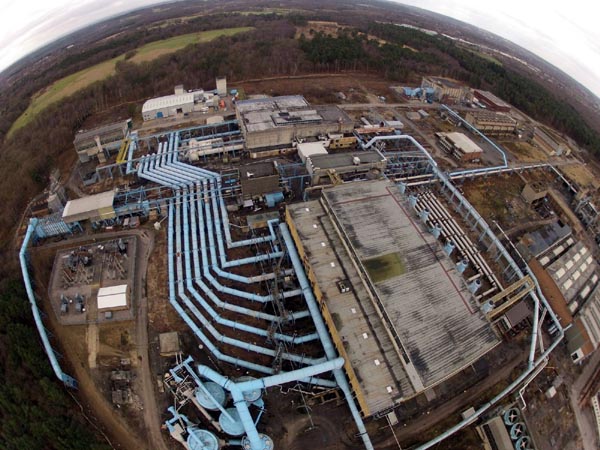
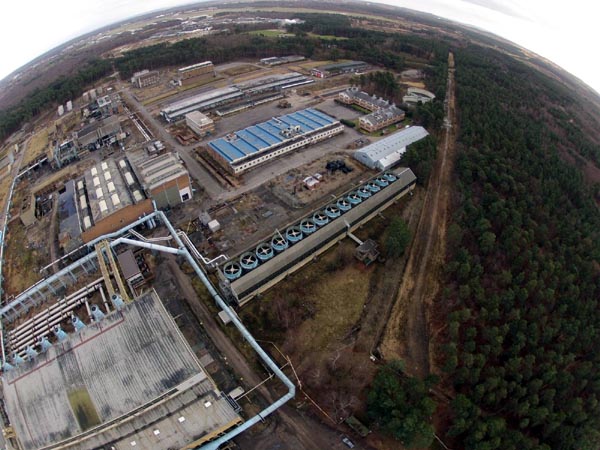
Pilgrimage is a record of my only visit to Pyestock during the
last decade.


After the publication of
The Aeronautical Activities Of The National Gas Turbine Establishment,
I've been able to expand and improve the Then And Now section:
- Air House: Replaced original picture of the G.E.C. Plant Room with uncropped version.
- Cell 4: Picture of the former Cell 3 Air Heater and the remains of its plinth.
- Cell 3 West: Added a pictures of the connected cell taken from
Number 10 Exhuaster and the cell nearing completion.
- Cell 1 & 2: Replaced general view picture with uncropped version.
- Cell 3: Added a picture of an Olympus 593 engine being lowered into the cell and of
another nacelle connected up for environmental trials.


Chris - from the 24|05|20 - sent in some more information about the Old Site and his time working there.
"Just to add, I managed to get hold of the 1999 aerial of the old site."
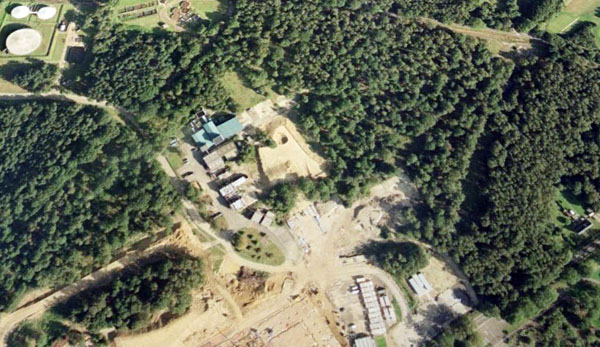
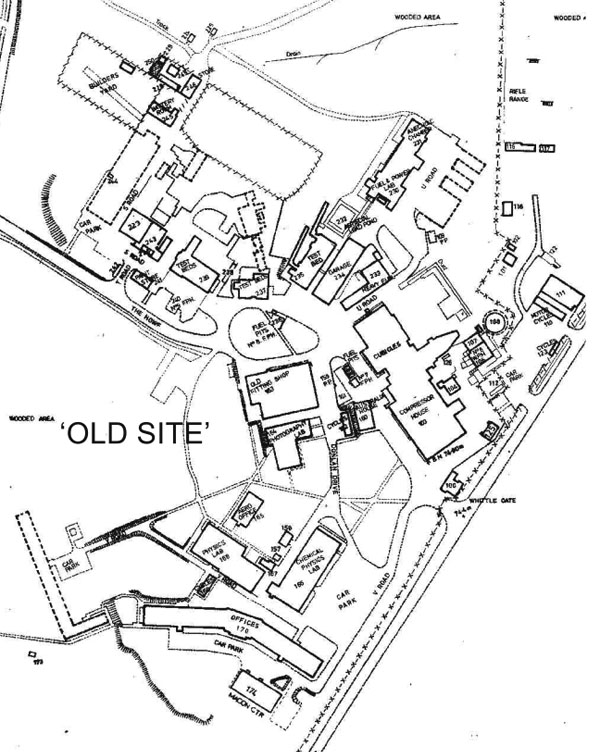
"There is a plan of the whole site included in
Chandler, J. (2005). The Former National Gas Turbine Establishment, Pyestock, Hampshire
which is referred to on your site - this shows the Old site quite clearly."
"I clearly remember engines in the test cells here being operated - they sounded like a huge blowtorch and
had a sound frequency close to 7 hertz, the resonant frequency of the human body - it certainly made you feel it running!"
"Many of the apprentices lived in a YMCA hostel run jointly for the RAE and NGTE - it was
located on the east side of RAE on a site now redeveloped as housing, at least the Farnborough college is still
there where we were required to do one day a week of day release education. Farnborough rag week was notorious - I was
there when the "spaceships" were distributed across southern England and hit the TV news - also the following year when
a space capsule was discovered in the Thames in London - both antics done by RAE/NGTE apprentices from the hostel."
"Sadly they had already started demolishing the old site in that aerial photo and the
historic Power Jets shed had already gone - it was just by the gate with faded signwriting on the side.
Also gone were the old offices where I had a room where I did experiments on afterburner valves, sitting
happily on the grass bank outside with a smoke machine, manometers and vacuum pump investigating airflow
in different configurations - the little test cell I designed had a perspex top so I could see the airflow patterns."
"With regard to the strange plastic wrapped objects near
Battle Test House - I was told they were parts of a Russian
plane - I think all of the TSR2 parts apart from the whole planes now in museums were transported to Shoeburyness near me - where
they were used for target practice - I remember the shrouded planes on low loaders passing by on the main road.
All these years later I still feel very angry about the demise of TSR2 and the politics involved."
"I still have a lathe tool holder painstakingly cut from blocks of steel with nothing more than a hacksaw,
file, hand drill and tap; a 1/2 litre oil can made from galvanised sheet steel, formed and soldered by hand and a
compressor blade liberated from Cell 4 where I assisted my scientific officer
working on Olympus 593 reheat systems."
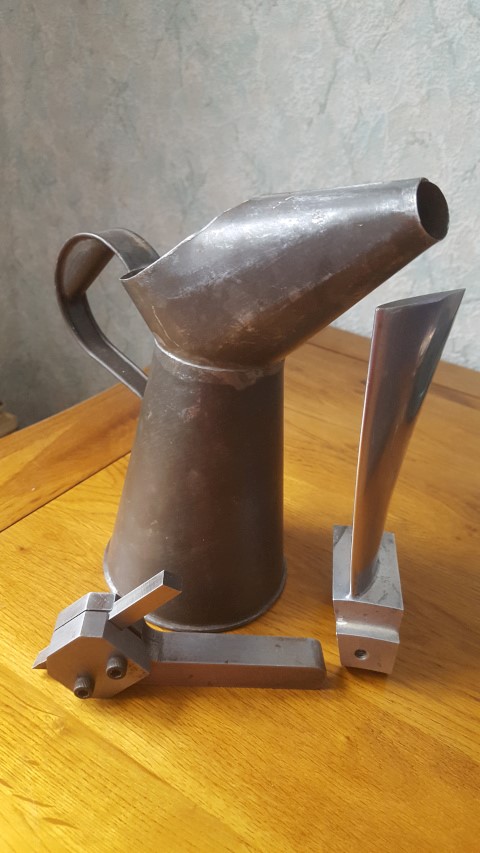
"In retirement until recently I ran a small business rebuilding MG sports car engines and still use
the tool holder on my lathe when I need a special tool shape. I haven't found a use for the blade other than
an ornament on my desk - but I still hanker for my own jet engine - if I could find a use for one!"
Chris


Many of the links in the Media Section are now dead. This isn't really surprising -
the Interent is a fluid construct and content is contantly shifting around. I'll leave the section as is -
a bit of Googling should locate most of the content if you are interested.
The MoLAS report has also disappeared - this time into an academic-only forum. A shame as I neglected to grab a
copy and wanted to cross-reference some of its content. It also interested me as it was a professional examination
of the site - I wanted to see how I could improve future works. If anyone grabbed a copy then could you email it to
me?


|
|
|
22|02|21
First things first. The ever helpful Richard Pinker sent me several documents over the last few years, which
I'm now uploading to the site. From his collection was this paper,
given to the Manchester Branch of the R.Ae.S in December 1973, which summarizes the organisation, function
and physical testing undertaken at the site. It's an important document as it provides a snapshot of
Pyestock before
the new Anechoic Facility was built, and includes black and white
pictures of the original Anechoic Facility.


|

|
13|01|21
After publishing the last of my photographs in 2013, I felt my contribution to the website was complete. It was
still open to additions from ex-employees, corrections and/or any archival information which turned up, but I felt my
days of driving down to Farnborough, getting past the fence, and sneaking around the site were over. I drew a line
under Pyestock.
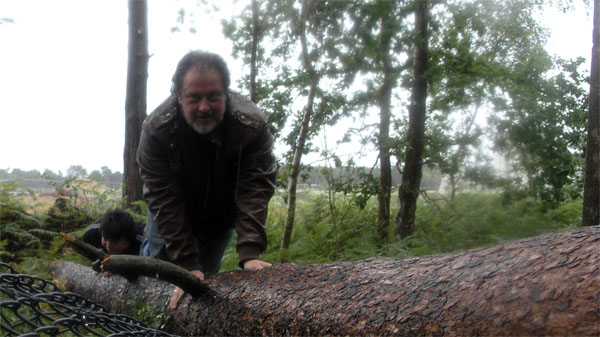
But after a lengthy hiatus from the urban exploration scene, and from Pyestock in particular, it was time to dust
down the camera, purchase some new tech, and head back to the wilds of Fleet Pond.
There was unfinished business to attend to.
Updates coming soon.


|

|
24|05|20
"I started my apprenticeship at NTGE in September 1968 so I remember the older parts of the site - sadly the
old site had gone completely by time you got there - the apprentice school was just past the old Whittle Power Jets hut by the east gate
and the shed with the vacuum gun that shot dead chicken carcasses at aircraft windscreens to simulate bird strikes.
"During my second year I was attached to a scientist working on afterburner controls for the Concorde engine - many happy hours
sitting on the grass outside the back of one of the sheds on the old site with a smoke generator and various designs of swirl pot.
"I also remember the jet turbine Rover 2000 which used to scream up and down the road between the old and new sites and the fire engine with
circular section helicopter blades that used to use the main runway to explore whether boundary layer control could replicate an aerofoil with
a simpler and stronger alternative.
"We also had issues with security - smuggling bits of metal out for our own projects (I still have some dexion "liberated" from the scrap bins) - bu
we were allowed to borrow tools if you had a chit and got it stamped at the gate.
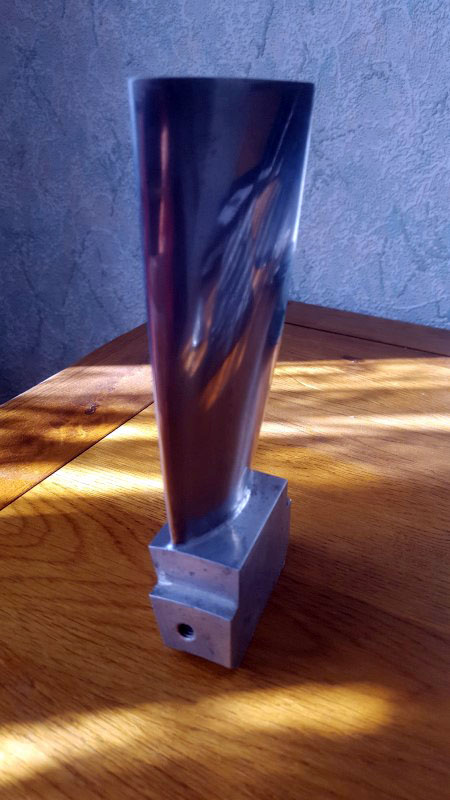
"Sadly I moved on to civil engineering after that but my time at NGTE is fondly remembered. I still have
some of the tools I made there and a compressor blade that was in the scrap bin - these were made on site in
a spark erosion machine that was situated in the main workshop.
"Just to add, I managed to get hold of the 1999 aerial of the old site.
"The apprentice workshop is the green roofed single storey structure at the top of the cluster of buildings - now in the middle
of the Cody Technology Park" - Chris


|

|
01|10|16
"I've been looking through your fabulous website on the NGTE and it has brought back a
lot of memories for me."
"My Dad worked at Pyestock from 1963 until he retired in 1982; like many others have said he
didn't say much about his job but I know he was working on the Concorde engine testing for much of its development.
Three other members of my family also worked there for a time and all four of them worked there together at one
stage which meant our surname was well known over the tannoy system throughout the site."
"Dad was a member of the Pyestock Bowling Club; now Cody Bowling and so was I for a time. He was bar officer
in charge of the bar in the Sports And Social Club for a few years and I spent many a Saturday there either playing
bowls or just messing about with friends while he did."
"I still have his bowling trophies along with three Pyestock ties complete with the crest on.
I remember once our dog managed to get under the fence and into the establishment itself, and Dad had to go up to
the main gate and get us both in so I could get her back."
"I also remember a family open day in the 70’s when we all got into the site to see the newly finished
Anechoic Chamber; I’m sure it hadn’t been completed long and I remember
going into it with my parents along with some other places which I can’t remember through the mists of time."
"We lived in Church Crookham in a 'tied' house that belonged to the NGTE; my parents moved
into it when it was first built in 1963 when they moved down from Scotland so Dad could start work at
Pyestock. We moved out into a council home in Cove near Farnborough in 1976; I now live in Bedfordshire
and my Dad passed away in 1992."
"I went to see what was left of the site recently following a visit to see my brother in Basingstoke; I went to the
Bramshot gate which I remember from when I walked our dog in the woods there in the late 70’s & early 80’s.
There is nothing left now which is a real pity as it was a part of history which we can’t get back."
"Thanks again for the wonderful website which should keep the memory of the NGTE alive for
years to come and to the adventurous few that took the risks to get the pictures before it all disappeared." - Steve


|

|
08|08|15
"As an apprentice starting in 1977 I was part of a group of 25 that year. After finding this site I have spent
the past 2½ hours going over the pictures and stories."
"It was a fantastic apprenticeship, "It will cost £1,000,000 to train you lot over the next 4-years" said Don Main,
the apprentice master on our first day. Along with Don was Roy Steadman, Wally Waterfield and Norman Pocock who
were managed by Brian Hatto, the Apprentice Manager."
"The 'Old Site' was where we all started with our basic skills training then sent off around the site
to learn more. Bay 7 was the maintenance workshop with all the fitters and electricians together,
Cell 4 (Concorde) was shut down in 1976 (I think) so we used to raid it for
bits and pieces; 9 &
10 machines were hot and noisy but absolutely nothing on working in
the Air House with the massive steam turbines/compressors. Synchronising
those at 2000 rpm (or was it 3000) MANUALLY to the grid at 11Kv was certainly nerve racking."
"Mentioning the Admiralty Test House,
Glen Test, and the other buildings brings back fantastic memories. Airplane magazine did a great article
on Pyestock last year, I have that laminated at work and when people ask about the UK
(I now live in South Australia) I hand them the pages and say “You’ve a lot to learn boy” as my apprentice
master Rod Bye (Cell 3 West) used to say."
"In 1981 I finished my 4-years and was stationed in the
BTH (Battle Test House) looking after all the electrical services,
one thing that I could never find an answer to was... at the rear of the BTH was a compound which had a
load of shapes all wrapped in a hard foam/plastic sheeting. On it was a notice saying if this covering
was damaged then to call a number and report it immediately?"
"I asked some of the old salts what it was and they said it was probably parts of some plane but not to
touch it, were these parts of the TSR2?"
"The boilers were being refurbished in 1982 then the contractors disappeared overnight, we saw
them a few days later on the new welding a helicopter deck onto the Canberra as the Falklands campaign got
under away."
"Each time I return to Farnborough (my folks live in Cove still) I look at the outskirts of the
site and remember the good old days playing for the Pyestock cricket team then returning
to the social club for a few beers and, if the tables were free, a game of snooker."
"Would love to get a hold of a photograph of my years intake, some of us are no longer here, rather
sad when you look back at young men being given a huge opportunity to get into a great engineering facility,
simply the best of its time."
Ian Thurston
Electrical Apprentice/Electrician
1977-1983

"I just wanted to say thanks for the website. You have obviously spent a lot of effort in
writing your experiences, and narrating the sequences of photos. The result is worth that effort."
"Really, the website represents a documentation of the place, in a way that nobody in government or in
the heritage sector seems to have bothered to do. I'm struggling to work out how to say it, but ngte.co.uk
seems like a work of national importance - and you would think that a museum or some part of the establishment
would want to preserve it. For it to be the work of one person, with the help of a small band of fellow
enthusiasts, is really staggering."
"Well done, and thanks for the enjoyment I have had following your tour of the site."
"Google Earth shows the site in process of demolition, with excavators and other plant around, and a
lot of what is in your photos vanished. I don't know how old that aerial photo is, but I'm guessing the site
has been cleared by now. So I'm guessing there will be no more new photos ever again."
"I've no connection with any of the site's history, so I'm afraid can't add anything useful to the story.
Indeed, I didn't know of the existence of Pyestock until a couple of days ago - there is
a passing reference to it in the book "Empire of the Clouds" which made me Google it..."
Chris Wright


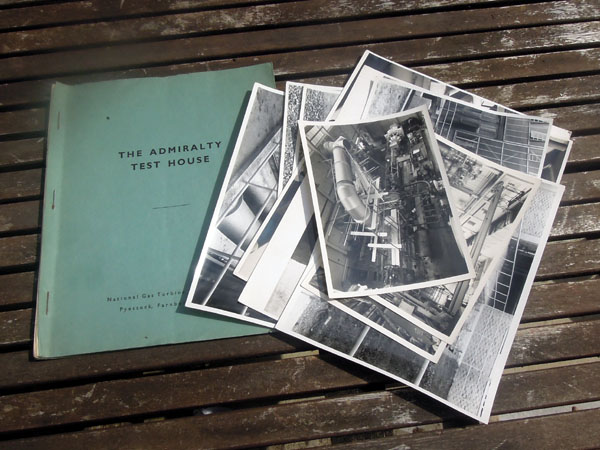
The site has now been totally demolished and cleared and as Chris states above, there will be no
more new photographs. That does not mean there won't be any more archival photos. I recently received a booklet
about the building of the Admiralty Test House so I'll be gradually scanning
this and adding it to the website over the next few months.
|
|
|
29|01|15
"I read your website with such saddness, I was an apprentice at the N.G.T.E. from 82 to 86 and then
was a fitter in the Admiralty Test House, I saw lots of good things along the way
and the one thing I have come to realise now is the knowledge I gained working in that environment helps me to this day.
The apprentice training I feel was second to none and the way the older guys taught people was fantastic. The
Admiralty Test House where I worked, researching and testing the Spey
gas turbine. I can remember working with my Charge hand Les Clarke
(the only name I can remember) on testing of the gas turbine, at that time is was to enter into service in the
Royal Navy's then type 22 Frigate. We tried to run the turbine on really weird concoctions of fuel mixture to enable the
turbine to run in just about any climate any where in the world and to understand that when it blew up the Navy could
repair it and understand why this happened. I still have my indenture apprenticeship papers on my wall at my home
in Bowmanville Ontario Canada and now after reading the update I finally am realizing that this journey is soon to
come to an end. - Derek Godfrey
"I have just come across your website on Pyestock and felt
prompted to drop you a note."
"I was recently in Farnborough for a couple of nights, so took the opportunity to have
a walk around the former Royal Aircraft Establishment site."
"In so doing, I found the old renovated buildings housing the now disused wind tunnels
(see www.airsciences.org.uk/windtunnels.html). I also found
a library now set up on the site (see aerosociety.cirqahosting.com).
"However, whilst researching the wind tunnels on the Internet, I came across information
regarding the National Gas Turbine Establishment at Pyestock in
Farnborough and subsequently your most informative website, which has been quite fascinating.
I also came across some documents at
archaeologydataservice.ac.uk/archsearch/,
searching for 'pyestock,' in particular
archaeologydataservice.ac.uk/archives/view/greylit/details.cfm?id=31797.
You may well have seen this, but I note it just in case."
"Having worked in the defence industry for 28 years I am amazed I was not aware of
Pyestock nor its sad demise. I note from a Daily Mail article
that soon after its part privatisation, Qinetiq sold the site for £31m (presumably
just chasing the cash), but it is just another example of the UK abandoning manufacturing,
unable to look past the short term. The destruction of the TSR2 military jet, which was years
ahead of anything else, the abandonment of the UK's space rocket programme, the cancellation
of the tilting Advanced Passenger Train, noting we now buy tilting trains from Siemens, all
sad examples. The cutting up of the Nimrod MRA4, the most capable maritime reconnaissance
plane in the world, as ordered by the current Tory government, wasting £4bn of investment,
did nothing to further manufacturing in the UK."
"I note from the archive document cited above that Rolls Royce took its high altitude
testing of its Trent engines to the US as it would have required Cell 3 West
to have been made bigger. What a shame there was no foresight for Qinetiq
or the UK government to invest in Pyestock so the work could have been done
in the UK. I wonder where the engines for the QE carriers have been tested?"
"Anyway, enough of the rant. What I really wanted to say is a big thank you to you
and your colleagues for all your work in capturing pictures and information about what was
clearly a fantastic test facility. I just wished I had been aware so I could have visited
the site before its demise." - Phil
"Thank you for all the work, effort and collation you have put into the website. It's a
fascinating read, I've gleaned a whole lot more from your site than I ever did in the two years
I spent at Pyestock in the mid 80s.."
"I'm not sure if you are still actively maintaining the website. I came across a film
Some Girls Do a rather poor James Bond spoof from 1969. The film
contains both exterior and interior shots of the test cells towards the beginning. Over the month,
I've been reminded of another TV sequence at Pyestock;
The Bill,
Des Taviner's final car chase and death was shot round the familiar blue pipes of Pyestock.
" - Scott
|
|
|
30|09|13
"I have been loving your site, bringing back many memories for me as it
was where I had my first "real" job as an engineer fresh out of University.
I was there from '87 to '96."
"I joined the diesel section of the Naval Mechanical Engineering Division
(NMED) - which like so many things in the MoD got renamed several times,
ending up as the Marine Engines' Branch. I started in 1987, working
mainly on Naval Diesel Engines in the Plant House.
The diesels were
housed in the C cubicles. The engines were often known by their
nicknames - C1 was the Trident (12 cylinder Paxman Valenta or Ventura
emergency generator for Nuclear Subs of the Trident Class), C2 held a
Paxman Ventura that I used for trials on submarine turbocharging. Both
those used the upper control rooms. C3 and C4 were not part of our
domain and I think were empty. C5 was split into several smaller
cubicles - your picture of the C5 cell shows the rails on the floor that
held the engines, but what is missing is that each was in its own
largely soundproofed chamber. The control rooms of the three "mini"
cubicles were down at ground level along the windows. I think the main
open area with the roller doors was C5a, and the three smaller cubicles
were C5b,c and d, though the a,b,c,d might have been the other way. The
one nearest C4 held the SSK (Ship, Submersible, Conventional, which was
the supercharged 16 cylinder Paxman Valenta for the Upholder class type 2400
submarines). I am pretty sure that is the engine in the picture Mike Graddage sent in.
To give an idea of size, Paxman Valentas are the
diesels found in the old InterCity 125 trains. The cylinder had a 7 1/2
inch bore and the 16 cyl supercharged one produced about 1.4 MW of power."
"Next along was the "Smurf" (SRMH or Single Role Mine Hunter engine - a
low magnetic engine) and then the "Dormouse" (A Dorman 6 cylinder). The
engines were operated and looked after by our fitters who were based in
the New Fitting Shop. The North end of the
New Fitting Shop housed machinery, the
South end workbenches for the fitters. The offices were for the PTO in
charge of them and the leading Charge Hand for the workshop, I think."
"The large open end part of C5 was empty when I joined but later housed
the Ruston RK270 - a beast of a 12 cylinder engine. that one was
controlled from the upper control room. The rest of the upper control
room was largely unused - but I did have equipment up there for applying
condition monitoring to engines - including an old IBM PC ATX (with a
colour display!)."
"Somewhere I have a couple of group photos of the Diesel Section all
standing in front of the Ruston. One with just us and the engine and
one with a Ruston Steam Traction Engine also there (the PTO for the
fitters was a steam enthusiast and arranged the visit from an an engine
that was at the Rushmoor Rally one year). When I find those pictures I
will scan them for you."
"Towards the end of my time at Pyestock I spent some time assisting with
data collection on the WR21 Naval gas turbine in the ATH.
The various references to Micky Mouse were because there was friendly rivalry
between the diesel section and the gas turbine section of the Marine
Engines Branch and we (the diesel team) decided the WR21 was a Mickey
Mouse project and declared the Plant House a Mickey free zone." - Eddie Kirkman
See also the Plant House (C5),
New Fitting Shop and
ATH Archive.
"First of all I wanted to say how much Ive enjoyed looking at your web sites. It really makes things
exciting for people like me who are a bit nervous to have a good explore through the eyes of people like yourself -who aren't!"
"Anyway about a two years ago I started to think about my grandfather, Arthur Connor,
who worked ( I was only a boy at the time) in Farnborough, he and my Grandmother lived in Ash Vale, and I often stayed
there in the 70s. He didn't talk about what he did at work, although one day he came home with some headphone/ear protectors
which had somekind of pick up that attached to the throat area and could pick up voice in heavy noise, so being from a
average family, in the days of a much poorer Britain, just played with them, of course he explained that they were
used when testing engines at work."
"Often Concorde could be seen flying into Heathrow from where they lived, and although he didn't ever talk about
what he did at work, he did say he'd worked on testing Concorde's engines. He's been dead since 1992, so I cant ask him.
Anyway, I put a few of the jigsaw pieces together and, I ended up on your amazing Pyestock website."
"As I worked my way through it amazed me to see where he worked, I then came across the picture of the two
fitters installing the RR engine, and felt pretty sure it was him - the man on the right hand side with the glasses/donkey
jacket/safety hat."
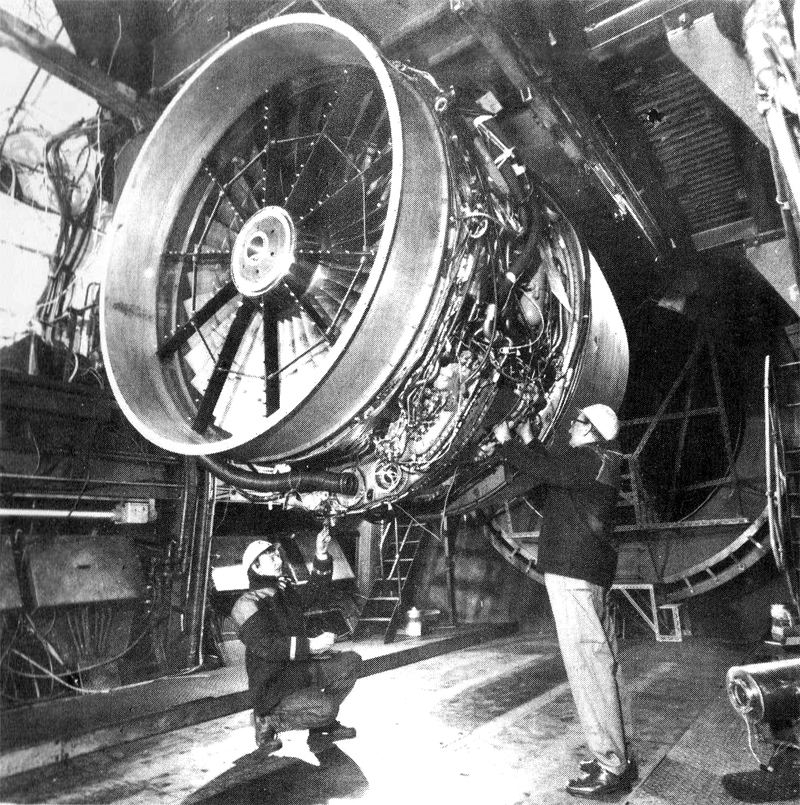
"I alerted my Mother to this,and she thought was/ might be him, and said that she recalled a picture of him
working at Pyestock, but that this had been in the local paper. My Mother also said that he was
very scrupulous about the security at Pyestock even cleaning out his turn ups so that no filings
or anything would leave with him by accident."
"My grandfather had worked at the Arsenal at Woolwich before, during and after the war, then he was asked to
work at the NGTE. My mother said he had been screened by MI5 at the house to examine his
political persuasions and signed the OSA because of the nature of the development of Concorde. I do recall
asking my grandmother who is also dead, what he did and she said she didn't know, although he came home with a cut on his
leg one evening and she inquired "how" etc. and he replied it had been done climbing out of a tank. So she thought he worked
on tanks and didn't have a single clue or even where he went to work!"
"Of course to us these people seem naive to us in our era of social media confessionals, but they weren't, they
were normal,decent people. But now we couldn't but imagine a couple talking to each other about their jobs, OSA or not!"
"My grandfather died of lung cancer, but there was some talk I overheard of an explosion at the NGTE
some year previous and many people had been exposed to asbestos. I do recall some of his colleagues had either died
or were suing the people at the NGTE circa 1990. This of course is hazy in my mind and I'm really not sure
if people even went that far, certainly my Grandfather didn't pursue it as he'd been a smoker all his life."
"That's it! No more stories, which is a sign of what these people were like, silent, authority biding. I think he
would be a bit angry and irritated that some secret files had been left on the floor as in one of the JPEGs, and I think he might
have wondered what all the effort fighting the cold war had been about! - but would have been proud to be part of great engineering
developments especially in civil aviation."
"So for me, your web site was a lost part of the puzzle, and really I can't thank you enough. It was an exciting time
to stay at their house, for example, next door lived one of the designers on the DH110 that crashed at Farnborough in 1952,
and the poor chap had become mentally ill after the crash (he blamed himself) and would often be spied upon through the fence
as he ranted meaningless equations and sentences. Most of these people have gone now, so for me your website was a kind of
testament to the cutting edge of engineering's bygone era."
"Anyway, not a particularly interesting email from your perspective, but many thanks for all your efforts
in unlocking the past." - Steve Miller
"Some of the most pioneering successes in jet engine technology were produced there,
I spent many hours peering through a periscope into the core of the RB199 triple system re-heat,
through to icing trials on the RB211 and Sea-king helicopter which fitted snugly into
Cell 3 West. My memories are extremely fond and plentiful
but as a government establishment the writing was always on the wall."
"Guess what? After one year after completing my apprenticeship I found myself on the Test Beds of British Airways,
all sea level stuff but still extremely exciting. Setting the max power governors on a Spey 512-14, three inches from your face,
beyond full throttle was about as good as it can get."
"My best memories are working closely with jet engines and the closer the better is where you would always find me.
It makes looking after 280 A/C departures at Term 5 seem quite bland by comparison."
"I don't have any photographs of those NGTE days, we were ALL made to sign the Official Secrets Act
and it was more than our lives' worth to even think about taking a camera in there. I was at the opening ceremony of the
Anechoic Test facility and stood behind Prince Philip and even for his tour
we had to cover up the EXTREMELY guarded workings of the RB199 re-heat system." - Mike
|

|
25|05|13
This update marks the publication of the final pictures I took during my exploration of Pyestock
in 2006 and 2007 and therefore this website is temporarily completed. I say "temporarily"
because there’s always the chance that more technical information may come to light,
or ex-employees may get in touch with more stories, or more archival photographs of the
site may surface.
Unfortunately the chance to take more photographs is now over. In February, the bulldozers moved in and
the demolition of Pyestock began. Several of the smaller buildings and structures
pictured on this website have now been demolished.
Such is the fate of all the buildings I've explored. But the loss of Pyestock is
particularly poignant as it’s a huge loss to the history of post-war industry in this country and
of our world-class endeavours in the development of the gas turbine.
"Soon there will be very little physical evidence of the existance of one of the most significant research capabilities of its type in the world" - Ian Mckenzie
The Documentation section continues to grow with details of Tom Kerr's self-published book Always A Challenge.
This site concludes with short detailed explorations of the CECA Plant,
the the New Fitting Shop,
the Bramshot Cooling Towers and
the Air House Cooling Towers.
More information about the F1 Kestrel which could be found in the Main Stores.
"I just stumbled across your website and although it's sad to see our hard work derelict and vandalised I thought
you might like to know that our "bird" finally flew.
See Farnborough F1 Kestrel Flies At Last" - Stephen Mosley
"The aircraft model shown in the website is in fact the engineering mock-up of the Farnborough F1, a single engine turboprop
air taxi. This was a project run by former land Speed Record holder Richard Noble, and commenced just after he had
led the Thrust SSC team in setting the first supersonic land speed record. My wife assisted Richard in setting up
the company, and was responsible for the day to day operation. (Her office was one of the small ones in the Fire Station),
I was employed as the documentation engineer and to work on designing the aircraft interior. The mock-up was built for two purposes;
it was used as a tool to develop the layout of the internal systems and as a publicity tool. (It appeared at the Farnborough
and other Air Shows). As a matter of interest, for quite a time, Thrust SSC was stored alongside the Farnborough F1 mock-up." - Steve Georgii
I will now return to work on my main urban exploration website,
urbex|uk,
and start publishing explorations from 2008 onwards. However, if any new
Pyestock material surfaces, then it will be published here.
|

|
08|11|12
Cell 4 has now been fully documented.
"Just found the site which brought back many fond memeories for me. Turbine testing was not the only
work undertaken at Pyestock. I was a civilian Scientific Officer serving in the Royal
Naval Scientific Service at the Admiralty Engineering Laboratory at West Drayton in 1976 when we
started transferring diesel test work to Pyestock as part of defence rationalisation."
"I worked in the Plant House until I left the MoD in 1985 and in
my 9 years there helped set up and run diesel engine development tests in C1, C2 and C5 cubicles.
I also had a test rig on the old site. Some of your photos show 'my' old (very noisy) office
which looked out over Cells 1 & 2. The photo of the walkway along the C
side shows not much had changed in the 22 years after I left."
"We undertook development of the diesels for the UK's last diesel electric submarine,
the Upholder Class, in addition to other work for submarines and surface ships. I see from
the photos taken in 2007 that all traces of the facilites I used in the cubicles has been removed.
If you are interested I have some photographs showing these circa 1980." - Mike
|

|
09|08|12
"Many years ago I was employed as a project engineer by a contractor which was supplying additional cooling plant for Cell 3.
We were doubling the quantity of coolant for testing the RB211 turbine."
"The facility no longer manufactured but tested power plants made elsewhere. I had a good look round and was fascinated by what I found.
I still remember walking through the fully equipped, but deserted workshops, full of machine tools which were never going to be used again.
I also spent a lot of time on the top of the coolant storage tank during the week watching the flying displays. It was Farnborough week."
"I can also remember attending a project meeting in an office across the street from a cell which was testing a early Harrier turbine.During the meeting there was a explosion from the cell and the sprinkler system drenched the cell causing a cloud of steam to be produced.
I was informed later that a home made plenum chamber on the air intake had been ingested."
"A later contract was for the IAM ( Institute of aviation medicine) next door to NGTE.
They had a cold chamber where they could simulate the conditions a pilot in a dingy could expect if shot down in winter.
The scientists would test the pilots ability to carry out tasks in extreme conditions.
All fascinating stuff.I can remember going home on Friday evening and returning for the public Farnborough show on the Saturday." - Ray
"Very interesting site. During 1977/78 I worked at a place called the
Admiralty Engineering Laboratory at West Drayton, having just finished
my apprenticeship at Devonport Dockyard."
"During my time in the drawing office myself and a colleague worked on
relocation of many AEL systems to NGTE Pyestock as part of the
consolidation and closure of MOD sites around the country. I do not
remember much about the visits, and only that we were moving generator
and other electrical test facilities to the site."
"AEL was an engine and electrical power systems facility. They had Deltic
and other propulsion engines in cells, used on minesweepers if I recall.
I worked on automatic synchronisation equipment required for multiple
generators on a ships power systems. There was also a major shock and
vibration facility, critical for survival of ships equipment when in
action. Unfortunately I moved on before the transfer of the site."
"Good times. Keep up the good work." - Jerry

Cell 3 has now been fully documented.

|

|
14|05|12
The Documentation Section has now been completed with the addition of the
Engine And Component Test Facilities - Issue Three. This comprehensive document
is an earlier version of the previously published Engine Test Facilities and includes several different
sections - most importantly there are sections on the Component Test Facilities (so there's more information about
the Plant House and Admiralty Test House) and a whole section devoted to noise testing
and the Anechoic Facility.
The whole Then And Now section has been updated with many new pictures.

|
|
|
06|01|12
The Document Section will be the next part of the site to be completed. So the next booklet uploaded is a
Recruitment Brochure from 1975 which gives an overview of the scientific work carried out across the
entire site. It's also especially interesting as it includes pictures of the interiors
of the Anechoic Facility.
Two pictures of this new brochure have been added to the Then And Now section for
Cell 3 West.
|
|
|
25|07|11
I have now completed the Pyestock Diaries section, uploading an account of my last exploration
(Magpie Abuse) along with an account of how the situation at the site changed in the next
year (Can You Guess Where I Am?) along with Major Tom's account of a narrow
scrape which occurred last year (Luncheoning With Security).
So with the whole urban exploration section is completed, I'll be moving onto getting the rest of the documentation uploaded.
|
|
|
28|06|11
I think this website currently stands at about half finished, considering the amount of archival material and current photographs
left to publish. So, after a lengthy pause, it's time to push forward and add some more content.
Firstly a warning to all urban explorers: "I would be a good idea to put a little side note on your website about the
fully active and operational test cell in the top left hand corner of the site. Vector test the T56, the Dart and the RR Conway
engine at Pyestock. Whilst the T56 and the dart are relatively quiet and well silenced engines, you can be
stood outside the cell chimney and just hear a quiet hum. The Conway is a different animal entirely this is a VERY LOUD engine,
it will shake you to your core if you are stood near the hush house. But long term hearing damage can occur if you are near the
cell for any longer than 15 minutes without hearing protection."
It goes without saying that certain areas of the old Pyestock site are still in use and that urban explorers should
stay well clear of them. Having said that, it's perfectly obvious which parts are still active: they look modern, are well kept, and usually
have several cars parked outside them.
"I have chanced upon your website that documents the tours of Aquila and Pyestock. It is strange that you have visited two places
that had such a profound influence on my life so far. I was an apprentice at Aquila from September 1980 until September 1985.
I worked at Pyestock as Engineering Manager in Cell 3W for a short while and then for a longer period in Cell 3 in the period
Jan 1995 to Nov 1999."
"I think that the building in Pyestock that you describe as the power station was in fact the cold air turbine.
This was connected to a 5MW alternator but the aim was to expand compressed air to produce cold, dry air for
altitude conditions; electrical power was a by-product. The main air compressors were much bigger with the
eight in the air house in the order of circa 27MW each. From memory exhauster numbers 9 & 10 were a bit smaller
than the original compressor / exhausters."
"I have enjoyed looking through the pictures from your first five visits to Pyestock. Unfortunately the links for
visit 6 & 7 do not seem to work".
"It is a fact that I was very lucky to have worked at this site when it was THE benchmark test facility of its kind.
I have no doubt that there are cheaper ways to produce the engine performance data these days but I doubt that we
learn as much from those methods! It is a real shame that we will never see this type of engineering in the UK again.
The political decisions that lead to closure were wrong. The commercial case for keeping the Pyestock plant running was
very real; GE wanted to test a programme of engines in Cell 3W beyond the scheduled closure. The reason it closed was
(in my view) due to the poor choices made by some ill-informed people during the formation of Quinetiq from DERA."
"The excellence that was developed at centres like EQD Aquila and NGTE Pyestock came from investment in good people
that had bold visions that served the needs of our country. The reasons they closed is because a few individuals did
not have the appetite to manage risk and harness technical excellence for the greater good. Those individuals chose their
personal wealth and "honours" over the on-going needs of our nation. Because of their poor decisions we have fewer options
for our young people to really learn and experience and practice engineering excellence in the UK."
"I left Pyestock before the closure and have gone onto work with a number of large blue-chip multinational companies. I have
experienced work in FMCG and service sectors. None of the corporations that I have worked for have demonstrated the vision
and innovation that was clearly evident in the British Government when they were investing in the MoD research facilities
and apprenticeships. But the UK Government bet that the market new best and let the corporate decision makers take over!
I firmly believe that the cost saved by closing those MoD blue sky programmes was a fraction of the wealth that would have
been generated by investing in their on-going operation. The accounting methods that ended these programmes based on
balance sheet risk neglected to take appropriate account of the opportunity cost resulting from their demise."
"Please excuse my rant but I find it very difficult to forgive those that neglect the value that Engineering should play
in our economy. A recent article in the Times presents the case more eloquently than I could: www.mappingbritishbusiness.co.uk."
"Thank you for the documentary of your adventures" - Andy
Ric has added to the Water Pumping House pages with a description of the operation of
the Plant House Pump House. He also had the following point:
"Isn't it about time that someone spoke up about Pyestock and the current ash cloud crisis?
This is exactly the sort of testing we used to undertake and could prove beyond doubt whether it is safe to fly
through ash clouds or not. I’m sure I remember Pyestock importing volcanic ash to carry out
such tests."
Andre has written in with memories of working in the Admirality Test House in 1954 along with
a photograph of the staff.
And the future of the Pyestock site has now been decided. All legal challenges have been swept away as the former government has
ordered the diktat that the mega depot will be built. The whole site (with the exception of one or two buildings still in use) will be swept
away.
See www.gethampshire.co.uk for the local
point of view and SPLAT's website for more information.
And I've started, and completed, the media section. This is a handly collection of all the appearances of
Pyestock in TV programmes and films.
|
|
|
02|03|10
This update is all about Pyestock's history. I’ve expanded the overlooked
History section (which was previously a lone comprehensive Then And Now)
with the naming of the site, a timeline, and a description of starting the turbines in the
Air House (and all the associated dangers) by Ric.
Plus there’s the real history of Pyestock as written and published by DERA
back in 1996 – which features some great pictures of the site in previous years.
(Thanks to Ric and Richard for the memories and scans which were used for this update).
Despite the lack of any urban exploration jaunts, or extra pictures, in this latest update, I’ve still got loads
of information to add to this site. I’ve got my last Pyestock Diary to upload, lots more archival information, and full descriptions
of the main testing cells to write up. It’s my intention to finish this website this year (which will probably coincide with the bulldozers
moving in) – so please keep an eye on it (and urbex|uk).
|
|
|
06|02|10
The Secretary of State for Communities and Local Government (DCLG) has effectively nullified democratic planning process and waved through
the redevelopment of the Pyestock site. Site owners PRUPIM and ProLogis reacted with predictable
glee and believe they have the go-ahead for their mega-depot: see their press release.
Except SPLAT are continuing the fight and will challenge through the High Court.
So, as usual, the future of the Pyestock site still seems open to debate. Of course, the whole thing will be eventually
demolished.
Our penultimate trip, the eventful Whatever You Just Pressed, Unpress It!, has now been written up.
I'm continuing to flesh out the site and have now written the introduction and the section on
urban exploration.
There are various fuel and water pumping houses scattered around the site. Therefore I've picked
Water Pumping House #10 as a representative example of them.
|

|
28|07|09
Updates to Battle Test House:
1,
2,
3 and
4. (With thanks to Bob who worked at Pyestock
from 1965 until 2004).
A brochure from the RAE era of Pyestock has now been uploaded: Altitude Test Facilities
briefly outlines the testing capability of several of the altitude test cells at Pyestock along with a description of the air
generating plant. Of most interest however, are the colour pictures of the various cells and control rooms in use.
These new archival photographs prompt an expansion of the Then And Now section: Air House,
Cell 1 & 2,
Cell 3 and
Cell 3 West.
Our misadventures at Pyestock continue in the write-up of my fifth trip to the site.
|
|
|
03|02|09
The Plant House is the next part of Pyestock documented.
This document from 1954 discusses the planned building of the Plant House; from the structure of the building itself,
through to the necessary plant and how it would operate with the rest of the site. Note that Cell 1 & 2 has yet to
be constructed (its called the Ram Jet Area) and
Battle Test House is called the 14000 H.P. Turbine Test House.
The full-write up along with the walkthrough can be found here.
The piece about the
International Stationary Steam Engine Society (ISSES) has been expanded with
an article they wrote about urban exporation. More details be found in
the academia section.
|

|
31|12|08
The write-up to to the Power Station has been updated: 1 and
2.
The boilers of Battle Test House were of particular interest to the
International Stationary Steam Engine Society (ISSES). They've published a piece about Pyestock
in their latest newsletter.
Many thanks to those who've sent me scans of old Pyestock brochures and documents. These will
start appearing on the site over the next few weeks along with a write-up of the next building to be fully
documented (which will be The Plant House).
|

|
21|08|08
The Maps and Plans section has been updated with all the various plans and schematics from the
Engine Test Facilities document. Several additional plans have been added including plans of
Cell 4 And Annexe (Number 9 Exhauster), the original 1954 siting plan of the
Plant House and a plan of the Plant House itself.
"Just wanted to say how much I appreciate the site. I served my electronics
apprenticeship at NGTE from 1972 - 1976 and then worked in Cell 3. Whilst
seeing some of the old rooms and kit brings back loads of very happy
memories, I find it very sad that it will all be wiped off the face of
Farnborough for ever."
"Anyway, thanks for bringing back my youthful good times." - David
A new section, Then And Now shows the differences between the photographs taken for
the Engine Test Facilities document and my photographs. Remarkably both the original photographer
and I chose the same vantage point for some of the shots, thus allowing a direct comparison of changes to the site over the
last twenty years.
"I stumbled across your website whilst taking a stroll down memory lane and looking for some information
on Pyestock. I worked there as a Data Acquisition Engineer from 1994 until its closure, first in Cell 3 West
and then in Cell 3 (in the EIC workshop that was sited in the former Cell 4 Control Room, next to the Photo
Room joined by Brian's Bridge).
Having had a long affilliation with both the airfield (having served an apprenticship there) and the Altitude
Test Facilities, it has saddened me to see it's fate should nothing be done to preserve it.
I therefore took the step of creating a petition on the 10 Downing Street website to call on the government to
step in and save the site and it's historic buildings. I would be grateful if you could forward details of
the petition to as many people as you can think of that would have an interest in this. I will be doing
the same as I still keep in touch with some of the guys I worked with during my time there.
The address for the petition is:
http://petitions.pm.gov.uk/savepyestock/
I hope you will agree with me that this is a crucial part of our British Aviation history that needs saving
for future generations to appreciate. " - Kieron
The often missed (by other urban explorers) Number 9 Exhauster has now been fully documented.
The introduction to the Computer Building has been slightly changed with corrections to
the installation dates of the various mainframe and mini-computers. (Thanks Mike).
|

|
14|05|08
This is a huge update and one which underpins the entire website.
Fellow explorer Stuart Dobson has scanned the entire Engine Test Facilities brochure; page after page describing
the history of Pyestock, the air supply installations, the engine test facilities, data gathering techniques and the
electrical, steam, water and fuel survices. I've converted to these scans to webpages, and enhanced the hundred archival pictures of
Pyestock along with the schematics, engineering diagrams and cross sections of the key plant and gear.
This document gives a definitive account of the facilities available at Pyestock in the early 1980s.
Over the next few updates, I'll merge all the data into other parts of the website, correct and expand the existing write-ups, and then
continue with my pictorial record of Pyestock.
The introductory page of the Engine Test Facilities is here.
|

|
24|03|08
Dave fills in some of the background behind the
Assembly Bays and includes a story about the night an
SAS training exercise went wrong.
After receiving an e-mail about the Computer Building, I decided to postpone my
documentation of the Plant House until the next update. The Computer Building
appears to have changed not only in function, but also in form, over the years.
"Very glad that you have taken the time to document Pyestock and some of its
history before that monstrous devil Tesco obliterates it for ever. I
sincerely hope they do not get their way. 61,000 vehicle movements a week
into the Pyestock site will destroy the local environment for miles around."
"I spent almost ten years at Pyestock starting as an apprentice, going on to
work in Cells 1 & 2,
Cell 3,
Cell 4 and the
Computer Building. I was an electronics
technician covering fuel systems, telemetry, data acciquisition in those
cells and eventually computers in building 574."
"I remember those years with fond memories of the whole site in full
operation with things steaming, creaking, roaring, Concorde engines in
Cell 4, Harrier engines and secret Russian things in
Cells 1 & 2. Cell 5 being
built, RB211 engines and whole Sea King helicopters in
Cell 3 West.
Battle House roaring away providing steam to the
Plant House, and running the site
in reverse during the miners strike putting many megawatts of electricity
back into the National Grid during the 3 day week, and of being an
apprentice and getting an engineering training second to none."
"It's a shame that parts of the site cannot be kept for some form of modern
museum to a jet engine aircraft industry that in it's day was a world
leader. Frank Whittle and Power Jets Ltd were apparently an instrumental
part of the original Pyestock scene, one of his engines stood in the
reception area for many many years." - Mike
Mike also drew a ground floor plan of the Computer Building
showing the positioning of the various computers and the function of each of the rooms.
As it has a close association with the Computer Building, I've also documented
Monk's Tunnel and other other tunnels nearby.
The rest of the DERA documentation specifying the capabilities of some of the test cells has now been
uploaded. There's an introduction along with specifications for the
Admirality Test House,
Cell 2,
Cell 3 and
Cell 3 West.
I've written up my third trip to Pyestock which took place exactly a year ago today.
David has written in with several additions and corrections concerning the boilers of the
Battle Test House so it's worth taking the walkthrough again to
read those. He's also supplied some diagrams of the Admiralty 3-Drum Boiler and
Forced Draught Blower.
|

|
19|01|08
"Having worked at Pyestock from 1984 until its closure in 2001 I had the
fortune to work in most of the test facilities from
Cell 2 to
Cell 3 West
and most of my time spent as the electrical PTO for the
ATH being involved
in two complete rebuilds for testing the SPEY SM1C for the Type 23
Frigate to my last engine which was the WR21 which is used in the new
Type 45 Destroyer."
"Like most of my colleagues who worked at Pyestock we had a great time and
had many friends and enjoyed the varied work immensely. It is nice to see
that someone has taken the time to put something together to document the
site and what it could do." - Nigel
Further additions to the Admiralty Test Cell include more details about some
of the rooms on the ground floor (and a couple of
extra pictures). I've also uploaded some DERA technical information about
the ATH.
Ric wrote in about how Pyestock's
unique atmosphere affected the plant life.
The Main Stores gets a full write-up. I wouldn't ususally spend so much time on such
a relatively insignificant building (especially when compared to the rest of Pyestock) but its current contents
are definitely worthy of mention.
"I just found your site and wanted to share my appreciation for what you
have done here. I was an apprentice at Pyestock from 1978-1982, in fact
my class was the largest of all the years with 24 apprentices. After my
apprenticeship ended I spent two more years there before moving on."
"I am
kind of glad that I was not around to see the demise of this once great
and still historic site. Even today I still think back and wonder what
happened to all the characters I knew when I worked there. Even then we
still explored the older buildings with a sense of wonder, one day we
even found some of Sir Frank Whittle's old test parts and papers which
were restored and put on display in the main office building (don't know
what happened to them since)."
"Even though your site left me feeling a little sad I was glad that it
will not be forgotten."
"Today I am working as a manufacturing engineer at Boeing in America
building the new 787." - David Peason
Architectural glossy Blueprint Magazine recently published an excellent piece
about urban exploration. Whilst it's great to be mentioned by name, it
also provides a handy historical background of the UK urban exploration scene.
Sister website, urbex|uk, has been invited by the British Library
to be archived as part of the UK Web Archiving Consortium: "The British Library would like to invite you
to participate in this work by allowing us to archive your web site under the terms of the appended licence. We select sites
to represent aspects of UK documentary heritage and as a result, they will remain available to researchers in the future.
We aim to subsequently include the archived copy of your web site in our permanent collections." This means that the Pyestock
pages on that site (which are included here as the Pyestock Diaries) will be archived by the Consortium as
a historical record.
|

|
21|11|07
This is just a small update as I've been working on a piece for my main urbex site.
The shell of the Admiralty Test House comes
alive thanks to comments from Pete who ran part of the facility
(and was able to give names and functions to the various rooms). It's worth taking
the interior walkthrough again.
You may have noticed an animated diagram of the WR21 project tests
(which I'm assured is now declassified). This was provided by Chris
who ran Cell 3 West for ten years and the
Admiralty Test House WR21 project for
two years. He's supplied further diagrams of Cell 3 West
which really help show how the cell worked.
Plus a bibliography has been added to documentation section.
|

|
13|09|07
One of the misunderstood, and sparsely photographed, buildings at Pyestock is the
Battle Test House. I've now added a summary of its functions and a walkthrough
of its various key areas.
The third entry of the Pyestock Diaries is now online. Your Guess Is As Good As Mine
is an account of our second trip to the site.
|

|
11|09|07
Whilst people have been creeping around Pyestock for months, one of the test cells is routinely
ignored and has hardly been photographed. So, it's time to redress this: the Admiralty Test House gets
the full write-up.
The Pyestock Diaries continue with an account of sitting around and fretting,
plus a rant against the current vogue for "macro" photography.
And I've published
my essay on urban exploration for the Construction History Society. It's partly concerned
with my plans for Pyestock (which ultimately lead to this website).
The first entries have been added to the Links section.
|

|
08|09|07
As this is a new site, you’ll find many of the links take you to holding pages. I'll gradually add to
these pages over time.
The
Virtual Tour section is complete. Feel free to explore. This provides a historical
background of Pyestock, together with brief descriptions of the key buildings on the site.
More detailed descriptions of the buildings will be added to
The Buildings section in due course. At the
moment, the
Power Station is the first building to get a
full write up, but you’ll find further information on all the key buildings in this section.
If you're in need of a map of Pyestock, then I've drawn one up
here.
Plus the Pyestock Diaries have begun with the first entry.
I hope you enjoy the site. Keep checking back. There's much more to come.
Simon Cornwell
|
| |